

The 5-Step Framework For Building Messaging That Converts
Your Messaging Isn't Broken Because It's Boring. It's Broken Because You Built It Backwards.

Most B2B founders start with their feature list and work backward to benefits. They think messaging means translating "what we built" into "what customers get."
This backwards approach is why 90% of startup homepages sound identical. Generic value props like "streamline operations" and "increase efficiency" that could describe any software or service ever built.
The real issue isn't your copywriting skills. It's that you skipped the most critical step: understanding what your customers do all day.
I've worked with dozens of B2B startups on their messaging. The ones that break through don't start with features. They begin with their customers' workflow.
Here's what changes when you flip your approach.
Note: The core insight for this approach originated from Emma Stratton's "Make It Punchy," which I recommend for those who want to delve deeper into the topic. I've refined her process based on what I've found to work with early-stage companies.
The Feature-First Trap (And Why It Fails)
Here's how most founders build messaging:
List all product features
Add benefits to each feature ("saves time," "reduces errors")
Create a value prop that summarizes everything
Wonder why prospects don't get excited
Here's an example I've seen: "Our AI-powered platform leverages machine learning algorithms to optimize workflow efficiency through intelligent automation."
Sounds impressive. Means nothing to someone with a real business problem.
Instead, start by asking what your best customers did before buying your software. Most know their features cold but may have never mapped their customers' day-to-day workflow in detail.
That's the core problem. You can't communicate value if you don't understand the specific work your solution replaces or improves.
The Workflow-First Alternative
Instead of starting with features, start with this question: What does your customer's typical workday look like when they're trying to solve the problem you address?
Map two versions of their workflow:
Current state: The manual, inefficient process they use today
Future state: How that same process changes with your solution
Take a Midwest software development agency I worked with. Instead of leading with "custom development services," we mapped their best customer's workflow:
Current workflow:
Manufacturing company needs support for custom operations software
Hire scattered freelancers or agencies for projects
No one focuses on ongoing maintenance
Systems break, and no one knows how to fix them
Business operations get disrupted
Growth stalls because technology becomes a bottleneck
New workflow:
Partner with one reliable development team
Get proactive maintenance and support
Systems stay running smoothly
The internal team can focus on business operations
Technology enables growth instead of limiting it
Notice the difference. The second version shows transformation, not just service delivery.
The 5-Step Process For Clearer Messaging
Once you understand their workflow, building clear messaging becomes systematic:
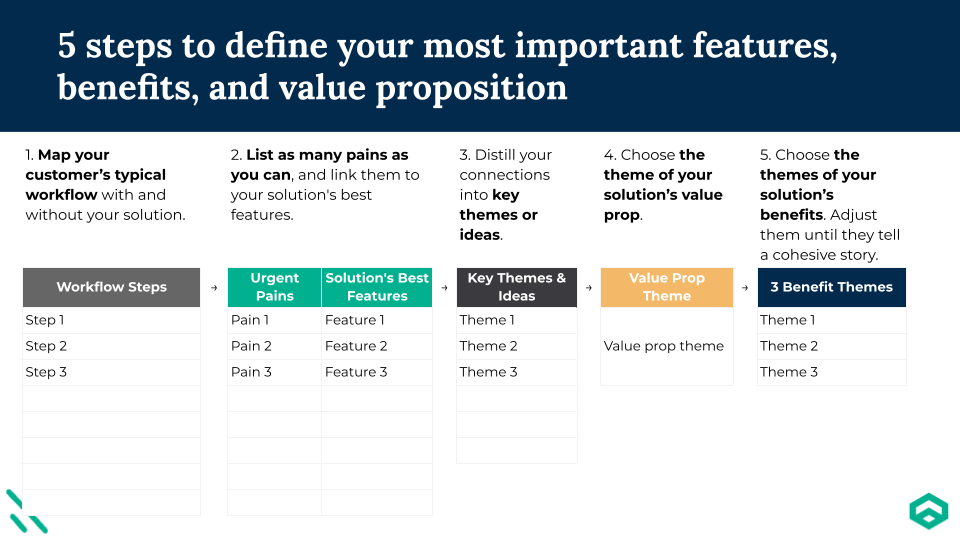
Step 1: Document every pain point in their current workflow. Be specific. Not "it's inefficient" but "takes 3 hours per client and can't be delegated to junior staff."
Step 2: Connect each pain to your specific features. This forces you to think from their perspective, rather than focusing on your product roadmap.
Step 3: Group related pains/feature combos into themes. Look for 3-5 major patterns that represent how you improve their world. Once you have your themes, you'll structure them using this formula:
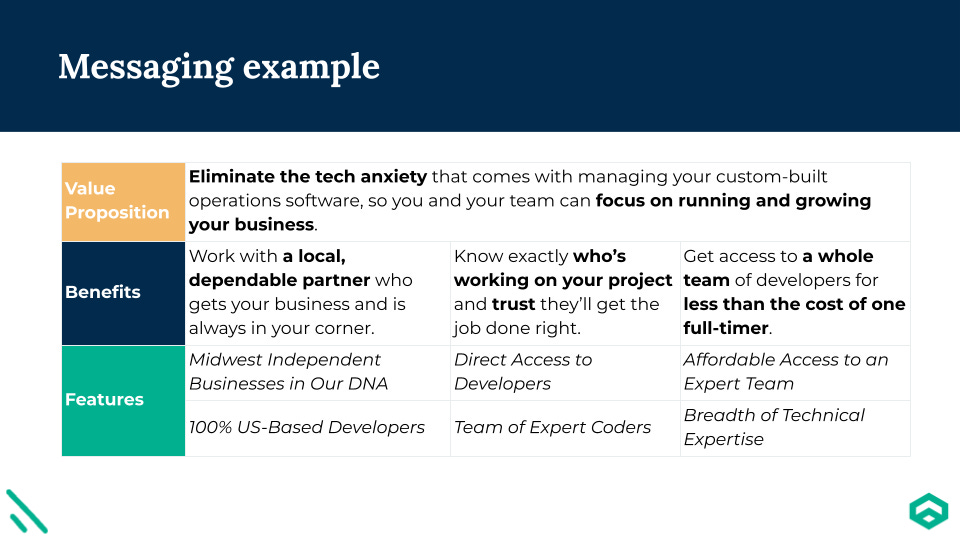
1 value proposition + 3 benefits + 2-3 supporting features per benefitThe value proposition is the big transformation they can achieve with your solution.
Benefits are what customers can do, be, or feel because of that transformation.
Features are the special things your solution has or can do that prove you can deliver each benefit.
Step 4: Pick your value prop and benefits. Pick the theme that best represents the value proposition. Then, pick the three themes that best describe the benefits. Adjust them until they tell a cohesive story that explains how you improve the old workflow.
Step 5: Select the 2-3 unique features that best support each benefit. Pick those features that best reinforce each benefit. Remember, you don't have to highlight everything. Focus on your unique features.
Here's an example of the final messaging for that manufacturing-focused dev agency:
Why This Process Works
Your benefits and value proposition translate features for your buyer into language they care about. They want to know what's in it for them before they care what you do.
Want proof? Companies that implement workflow-first messaging see real results. Here are a few examples from clients I've worked with:
340% increase in conversion rate from first meeting to closed (from 5% to 17%)
22% increase in tier 1 demo requests in the first month
103% increase in demo requests from their website over the first quarter
The reason? Prospects finally understood what these solutions actually did for people like them.
Where Most Companies Still Mess This Up
Even when founders understand the workflow-first approach, they make predictable mistakes:
Wrong messaging altitude for the audience. Don't explain APIs to a CEO. Don't give high-level benefits to a technical buyer who needs implementation details.
Too many benefits. Three maximum. More than that, and you dilute your core message.
Corporate language. Write like your customer would explain your solution to a friend at a barbecue. Strip out jargon and corporate speak.
Skipping the pain mapping. You can't communicate value without understanding specific problems. Generic pains lead to generic messaging.
The Implementation Reality
This process usually takes a few weeks if done correctly. Not because the steps are complicated, but because it takes time to interview customers and document their workflow.
AI can help speed this up. After you interview customers and map their current process, upload those notes and use AI to help identify patterns and refine your messaging. But you still need the customer research first.
The framework works whether you're selling a $50/month tool or a $500K enterprise solution. The process remains the same: understand their workflow, identify the specific pain points, and build messaging that showcases transformation.
Most startups spend months tweaking copy when their real problem is that they built their messaging backwards. Start with workflow. Everything else falls into place.
P.S. Positioning and Messaging are my favorite projects to work on. If you need help clarifying yours, reach out.