

The GTM Strategy Health Assessment: Find Your Growth Bottlenecks in 10 Minutes
Find Your Real Growth Bottlenecks With This 42-Question Diagnostic

Most B2B startups and agencies think they know what's holding back their growth. They're often wrong.
After working with dozens of early-stage companies, I've observed a consistent pattern: founders often blame their growth problems on execution issues when the real issue is strategic. They'll say "we need better content" when their positioning is unclear. Or "we need more leads" when their offer doesn't resonate.
The truth? You can't execute your way out of a strategy problem.
That's why I created this GTM Strategy Health Assessment, a diagnostic that reveals exactly where your GTM strategy is breaking down and what to fix first.
Why Most GTM Diagnostics Miss the Mark
Traditional business assessments often ask surface-level questions about tactics and metrics. They may ask about your conversion rates or lead volume, but miss the foundational issues that drive those numbers.
This assessment is different. It focuses on the 8 core areas that determine whether your GTM strategy will scale:
Solution–market–problem fit - Do you solve a real, urgent problem for a clearly defined audience?
Ideal customer clarity - Do you know exactly who your best-fit customers are?
Offer clarity and structure - Is your core offer repeatable, understandable, and aligned with your ICP's must-fix problem?
Pricing-value alignment - Does your pricing reflect customer value and support sustainable growth?
Messaging and positioning - Can you explain what you do, why it matters, and how you're different?
Channel and motion fit - Are you consistently reaching new buyers through the right channels?
Internal clarity and alignment - Is your team focused, aligned, and executing without chaos?
Executional maturity - Are you translating strategy into action and learning fast enough to grow?
Why Self-Assessment Matters (But Is Also Hard)
Most founders assume they know who their ideal customer is, what messaging will resonate, which offers will convert, and which channels will scale. But we're wrong more often than we're right.
The curse of knowledge clouds our judgment. We built it. We live it. We're too close to see it clearly.
When I posted about this on LinkedIn, one commenter put it as: "It's super hard to self-assess. You're in the business deep and biased in what you think exists and is done."
Another noted: "Solomon's paradox is real. I can give solid advice to my clients about sales and growth, but when it comes to applying that same advice to my own business, I struggle."
This proximity creates dangerous blind spots. That's why a self-assessment, while valuable, shouldn't be your only reality check. You need multiple perspectives:
Your team: Have 2-3 team members complete the assessment separately, then compare scores. If you get wildly different answers to "We know exactly who our ideal customer is," you've identified an alignment problem.
Your customers: Share key questions with recent buyers. Do they describe your value the same way you do? Do they see you solving the problem you think you solve?
Trusted outsiders: A coach, consultant, or smart peer with zero emotional attachment can challenge assumptions and spot what you can't see.
Clarity doesn't come from expertise. It comes from distance.
The Assessment Framework
This assessment focuses on 8 core foundations that determine go-to-market success:
Foundation-Level (Sections 1-3):
Solution–market–problem fit
Ideal customer clarity
Offer clarity and structure
Execution-Level (Sections 4-6):
Pricing-value alignment
Messaging and positioning
Channel and motion fit
Operational-Level (Sections 7-8):
Internal clarity and alignment
Executional maturity
Each section contains 5 questions designed around observable behaviors rather than intentions.
For example, instead of asking "Do you understand your customers?" it asks "If I asked 3 team members to describe our ideal customer, I'd get the same answer."
How to Interpret Your Results
Scores (1-5) are averaged for each of the 8 sections. Here's what they mean:
4.0-5.0: Strong Foundation
This area likely isn't your growth bottleneck. Maintain current performance and allocate resources elsewhere.
3.0-3.9: Moderate Weakness
Room for improvement, but probably not your highest priority unless other areas score higher.
2.0-2.9: Significant Gap
This area needs focused attention and may be limiting your growth velocity.
1.0-1.9: Critical Weakness
This is likely your primary growth bottleneck. Address this before optimizing other areas.
Most companies have 1-2 critical weaknesses and 2-3 significant gaps. The key insight isn't identifying problems, it's determining which problems are actually blocking growth.
The Final Two Questions
The assessment ends with two reflection questions that often provide the biggest breakthroughs:
"On a scale from 1-5, how confident are you that your answers reflect reality, not just hopes or best-case thinking?"
"If you had to pick just one of the 8 sections above as your biggest barrier to growth right now, which would it be?"
Question 1 forces honest self-assessment. If you score yourself below 4, your real problem might be a lack of customer feedback and market validation.
Question 2 reveals your intuitive understanding of your business. Often, founders know exactly what's wrong but need permission to focus on it instead of chasing other priorities.
Common Assessment Patterns and What They Mean
Pattern 1: Low scores across Sections 1-3
You have a foundational strategy problem. Before optimizing channels or improving execution, you need clarity on your customer, offer, and positioning.
Pattern 2: Strong Sections 1-5, weak Sections 6-8
Your strategy is solid, but execution is lacking. Focus on channel testing, team alignment, and systematic growth processes.
Pattern 3: Scattered weak scores
You're likely trying to do too much at once. Pick the lowest-scoring section and fix it completely before moving to the next.
Pattern 4: Everything scores 3.5-4.5
You may lack sufficient customer feedback to accurately assess your position. Conduct 5-10 customer interviews before retaking the assessment.
From Assessment to Action
The assessment identifies problems but doesn't solve them. Here's your next-step framework based on where you score lowest:
If Foundation-Level sections (1-3) are weakest:
Your strategy needs work before optimizing execution.
Conduct 5-10 customer interviews with recent buyers
Document the specific language customers use to describe their problems
Simplify your core offer to address one primary pain point
Test messaging variations based on customer language
If Execution-Level sections (4-6) are weakest:
Your strategy is generally correct, but the implementation requires refinement.
Test pricing approaches with 5-10 prospects in sales calls
A/B test messaging variants on your website
Audit competitor positioning to identify differentiation opportunities
Focus on one customer acquisition channel for 90 days
If Operational-Level sections (7-8) are weakest:
You have the right strategy, but you lack the systems to execute it consistently.
Implement weekly GTM team meetings with structured agendas
Create experiment tracking and review processes
Define clear roles and accountability for GTM execution
Document and standardize your sales and marketing processes
Take the Assessment
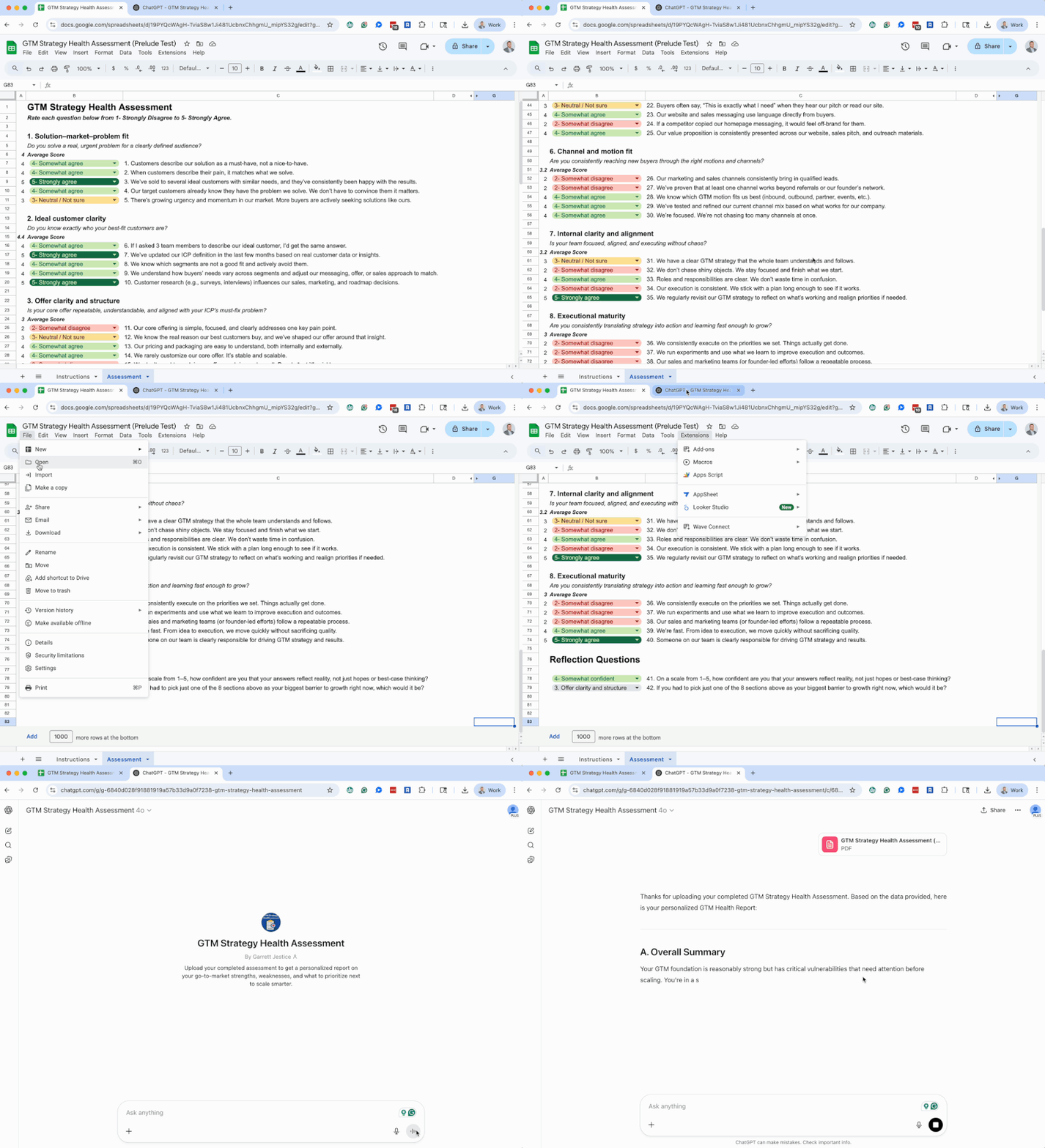
For all readers: Below are the complete 42 assessment questions organized by section. Copy them to a spreadsheet and rate each from 1 (Strongly Disagree) to 5 (Strongly Agree), calculate averages, and identify your weakest areas.
For paid subscribers: Access the full Google Sheet template plus custom GPT analysis that provides personalized recommendations based on your results at the end of this post.
1. Solution–market–problem fit
Customers describe our solution as a must-have, not a nice-to-have.
When customers describe their pain, it matches what we solve.
We’ve sold to several ideal customers with similar needs, and they’ve consistently been happy with the results.
Our target customers already know they have the problem we solve. We don’t have to convince them it matters.
There’s growing urgency and momentum in our market. More buyers are actively seeking solutions like ours.
2. Ideal Customer Clarity
If I asked 3 team members to describe our ideal customer, I’d get the same answer.
We’ve updated our ICP definition in the last few months based on real customer data or insights.
We know which segments are not a good fit and actively avoid them.
We understand how buyers’ needs vary across segments and adjust our messaging, offer, or sales approach to match.
Customer research (e.g., surveys, interviews) influences our sales, marketing, and roadmap decisions.
3. Offer Clarity and Structure
Our core offering is simple, focused, and clearly addresses one key pain point.
We know the real reason our best customers buy, and we’ve shaped our offer around that insight.
Our pricing and packaging are easy to understand, both internally and externally.
We rarely customize our core offer. It’s stable and scalable.
We don’t need to explain our offer much in a sales call. People “get it” quickly.
4. Pricing-Value Alignment
Our customers believe our price is fair, given the outcome we deliver.
Price rarely becomes a sticking point when we’re talking to ideal buyers.
We’ve tested pricing changes based on customer value and market data, rather than relying on guesswork.
We don’t discount often, and if we do, it’s strategic.
Our pricing supports healthy margins, allowing us to reinvest in growth.
5. Messaging and Positioning
Our team is aligned on a single, consistent way to explain what we do and who we help.
Buyers often say, “This is exactly what I need” when they hear our pitch or read our site.
Our website and sales messaging use language directly from buyers.
If a competitor copied our homepage messaging, it would feel off-brand for them.
Our value proposition is consistently presented across our website, sales pitch, and outreach materials.
6. Channel and Motion Fit
Our marketing and sales channels consistently bring in qualified leads.
We’ve proven that at least one channel works beyond referrals or our founder’s network.
We know which GTM motion fits us best (inbound, outbound, partner, events, etc.).
We’ve tested and refined our current channel mix based on what works for our company.
We’re focused. We’re not chasing too many channels at once.
7. Internal Clarity and Alignment
We have a clear GTM strategy that the whole team understands and follows.
We don’t chase shiny objects. We stay focused and finish what we start.
Roles and responsibilities are clear. We don’t waste time in confusion.
Our execution is consistent. We stick with a plan long enough to see if it works.
We regularly revisit our GTM strategy to reflect on what’s working and realign priorities if needed.
8. Executional Maturity
We consistently execute on the priorities we set. Things actually get done.
We run experiments and use what we learn to improve execution and outcomes.3
Our sales and marketing teams (or founder-led efforts) follow a repeatable process.
We’re fast. From idea to execution, we move quickly without sacrificing quality.
Someone on our team is clearly responsible for driving GTM strategy and results.
Reflection Questions
On a scale from 1-5, how confident are you that your answers reflect reality, not just hopes or best-case thinking?
If you had to pick just one of the 8 sections above as your biggest barrier to growth right now, which would it be?
The GTM Strategy Health Assessment cuts through assumptions to reveal what's blocking your growth. As one LinkedIn commenter said, "Without a baseline, it's not testing. It's just hoping something sticks."
This assessment provides that baseline. Stop guessing and start measuring.
Paid subscribers: Access the full GTM Strategy Health Assessment Google Sheet template, plus custom GPT analysis that provides personalized recommendations based on your results here: