

How to Create Your Messaging Architecture
Your messaging architecture guides what you say and how you say it to your target audience. Here's how to create one for your small business.

What is a messaging architecture, and why do you need one?
Clear communication is the foundation of any healthy relationship––including the buyer/seller relationship.
Once you've determined your best-fit customers, the next step is deciding what to say and how to say it.
That is where your company's messaging architecture comes in.
Your messaging architecture guides what you say and how you say it to your target audience.
There are two things a messaging architecture can help your business accomplish:
Clear and confident messaging about your role and relevance in your market.
An aligned and focused go-to-market team that can speak to what you do.
Here's what the typical messaging architecture includes:
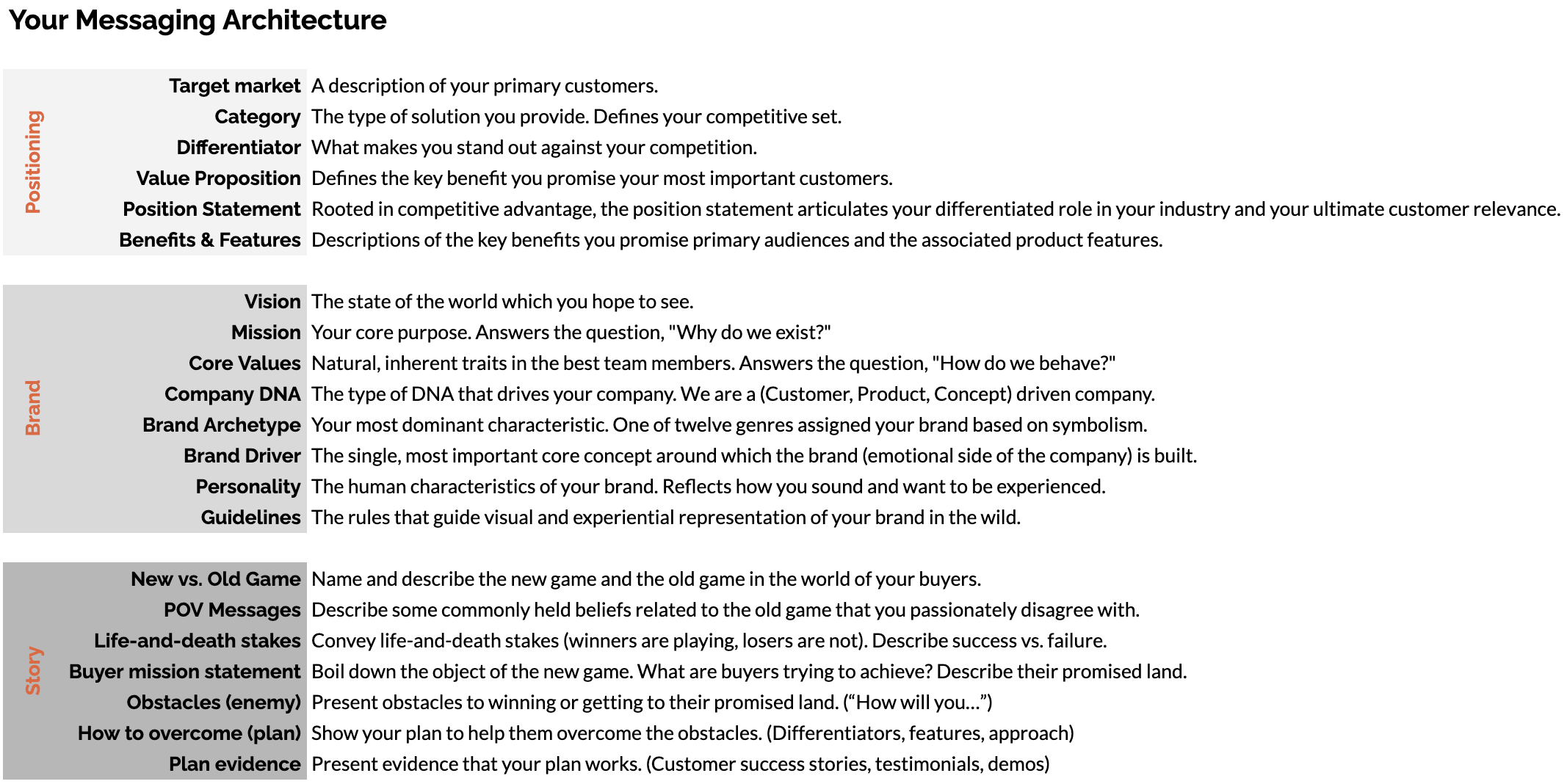
Get your copy of my messaging architecture template here.
There are three critical pieces of an excellent messaging architecture:
Positioning: The expression of your company's strategy in precise phrases that convey competitive differentiation, role, and relevance.
Brand: The expression of your company's strategy in words, tonality, color, design, imagery, and illustrations.
Story: The expression of your company's strategy in an emotionally charged story that convinces and converts prospects.
Your messaging architecture is the foundation for all external communication and internal team alignment.
Creating a messaging architecture is an exercise in company strategy––not a fluffy marketing activity.
It's about aligning your entire team on how to speak about what you do and why you do it.
As a result, I always recommend that founders lead this process for their teams and bring in other key leaders to participate.
In this post, I'll walk through how founders can lead their teams to develop a messaging architecture for their companies. Let's get to it!
The 4 step messaging architecture process
There are four main steps in my messaging architecture process.
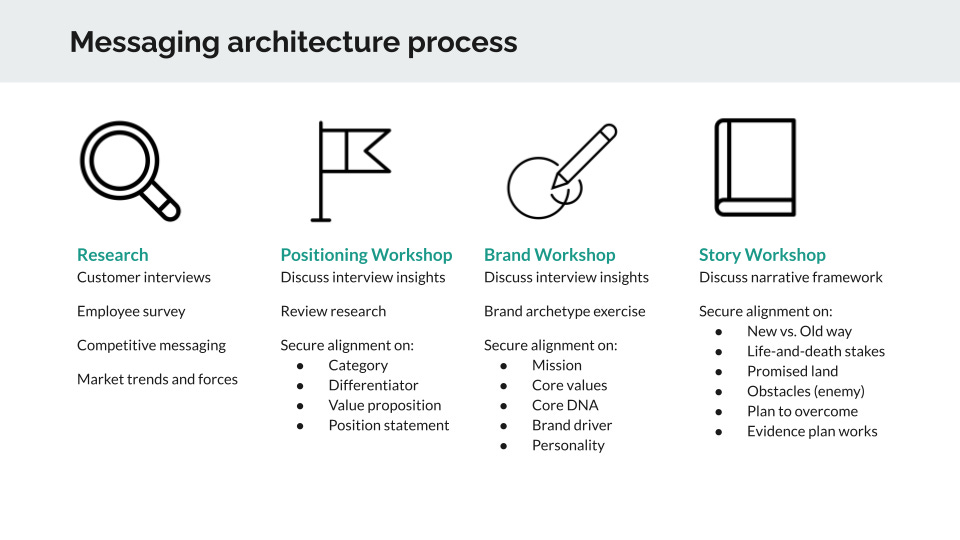
Step 1: Research
There are four "lenses" I like to look through to inform messaging: (1) employee perspectives, (2) customer perspectives, (3) competitive messaging, and (4) market trends and forces.
The findings from researching these lenses inform the discussion in the three workshops.
Employee perspectives
If your messaging architecture will help drive alignment with your team, it's essential to consider their perspectives.
Plus, frontline, customer-facing employees usually have the best pulse on the messaging that resonates with prospects and customers.
The easiest way to gather their perspectives is with a short survey.
I prefer to use Google Forms for this because it's free and easy, but you can use any survey tool you'd like.
Customer interviews
The next step is to perform 5-10 interviews with your best-fit customers.
It is crucial to ask similar questions to employees and customers to be able to compare their perspectives side-by-side during the workshops.
In this post, I discussed this customer interview process in more detail. Check it out to get your copy of my questions and templates.
Competitive messaging
In addition to considering the perspectives of employees and customers, it's also helpful to look at how competitors are messaging their products/services.
Competitive messaging can help you differentiate your offerings to stand out.
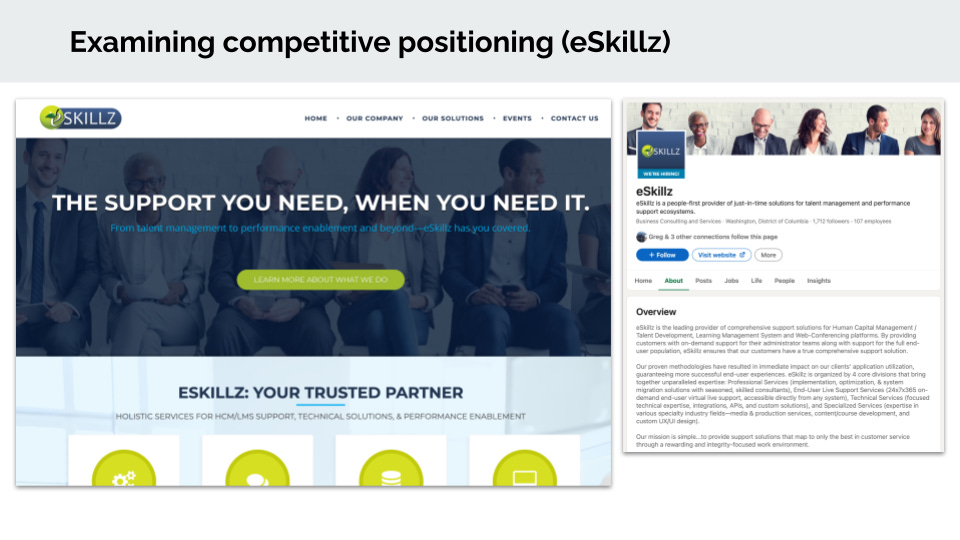
To do this, I recommend identifying your top 3-4 most common competitors and taking screenshots of their website homepages and LinkedIn company profiles like this:
After that, you can summarize the positioning, brand, and story elements of all competitors you looked at side-by-side like this:
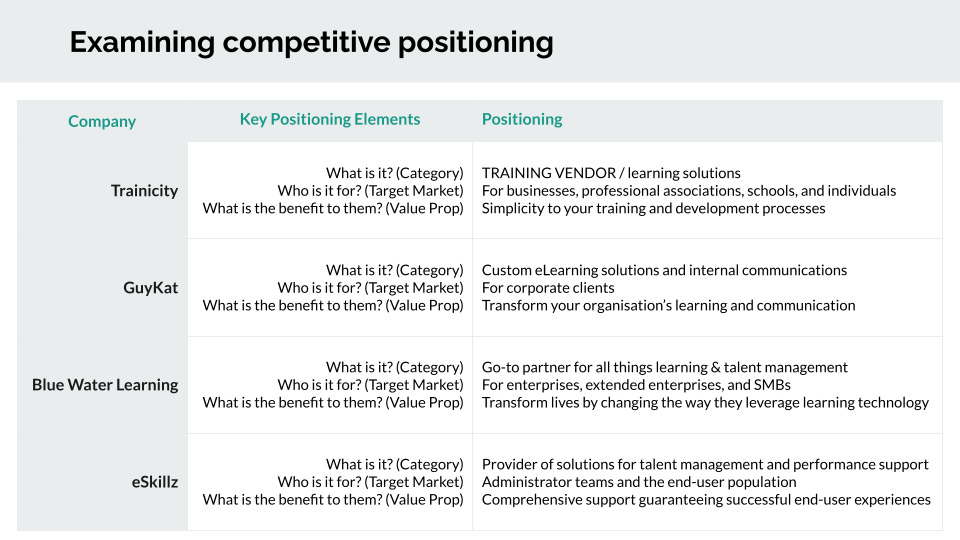
This approach helps you start to spot common themes and whitespace opportunities to focus your messaging on.
Market trends and forces
The last thing to research is market trends and forces.
There are a few ways to do this:
Google the most common market trends mentioned by employees and customers in response to your survey/interview question: "Why is now special for our company? What trends and forces are shaping the market that you've seen?" Do you see secondary research about those trends from reputable sources? How should that inform your messaging?
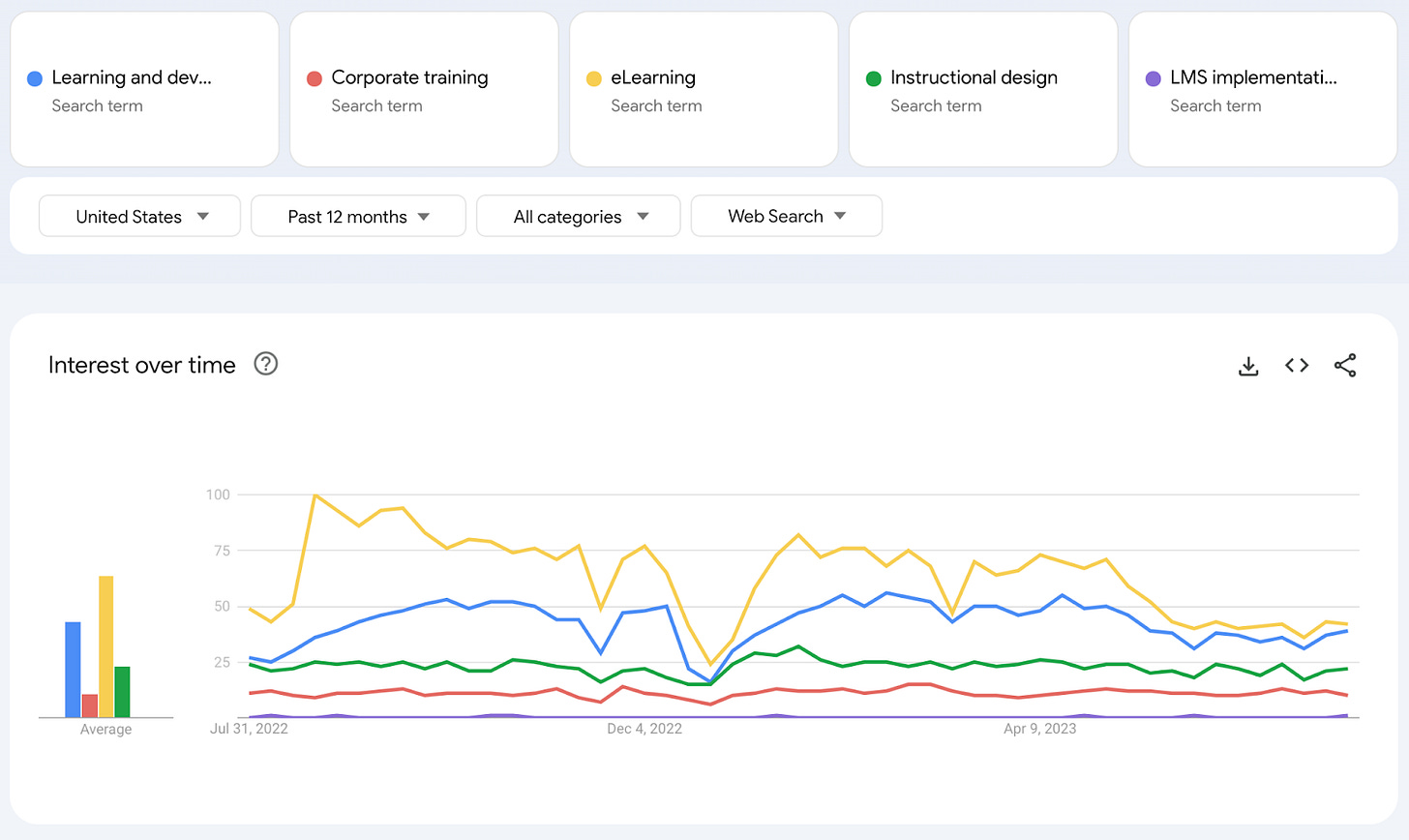
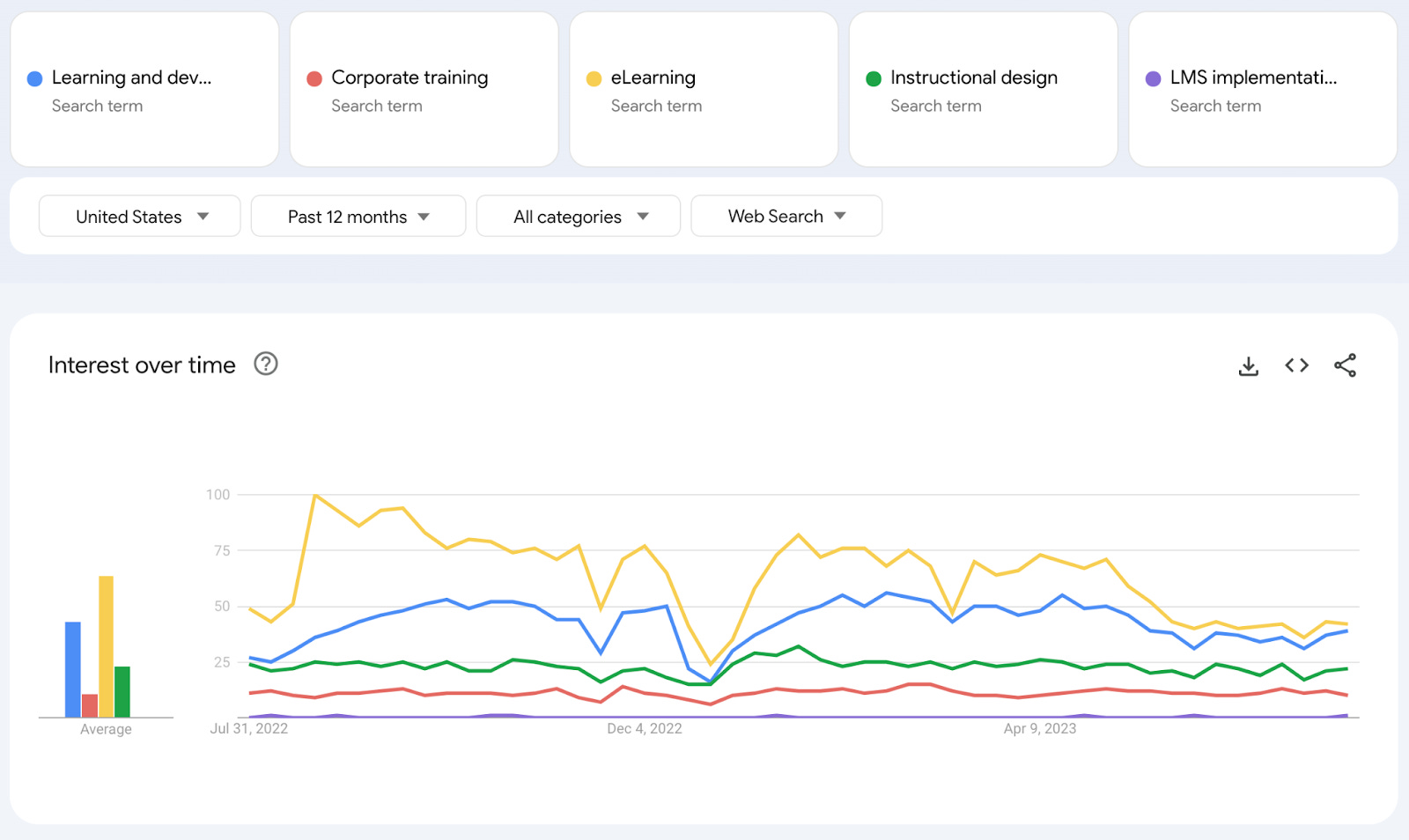
Look at Google Trends for the different category terms you're considering. This can help you know if specific terms are more popular than others or are growing in popularity. Here's an example:
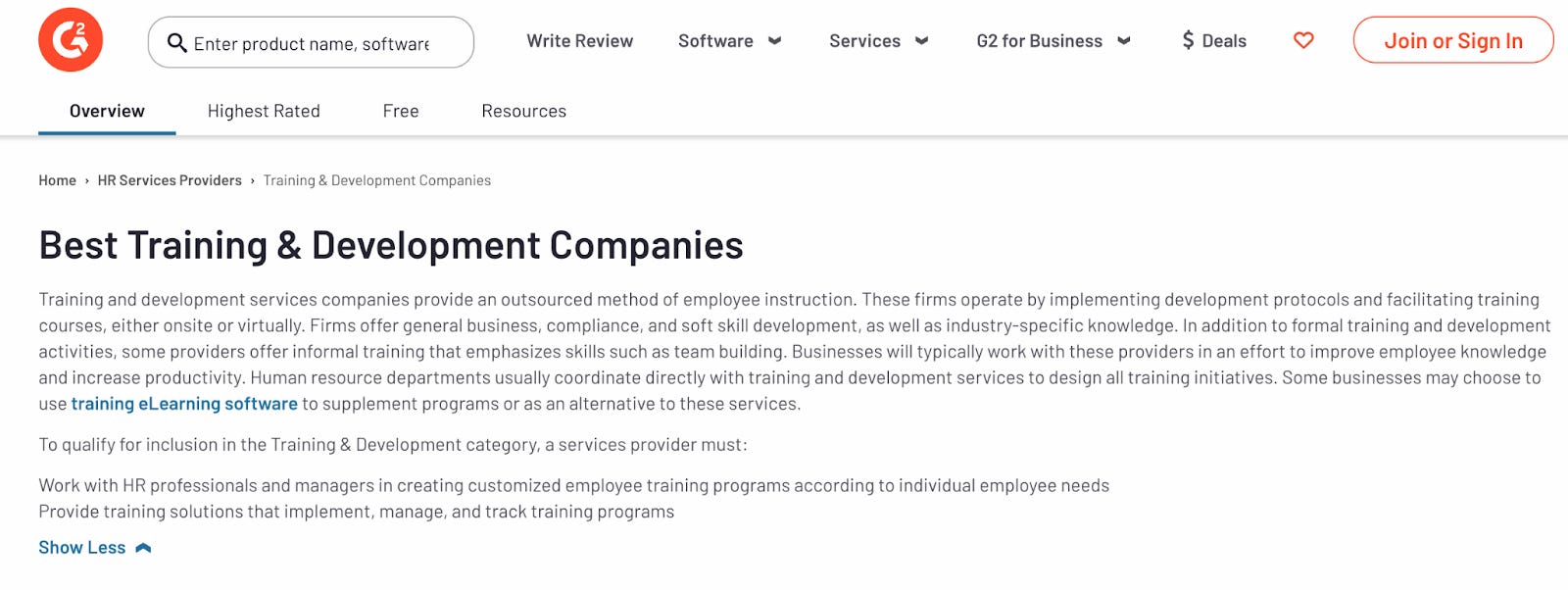
Look at how popular directory sites like G2 describe your product/service category and trends. Consider how (if at all) this should impact your messaging.
Phase 2: Positioning Workshop
After completing your research, the next step is to run a positioning workshop with your company leadership team to discuss and align on the six parts of positioning.
Usually, this process takes 2-3 hours, depending on how many people are present and how much discussion there is.
The goal should be to use the research you just gathered to inform a discussion that results in clarity and alignment on the six parts of your positioning:
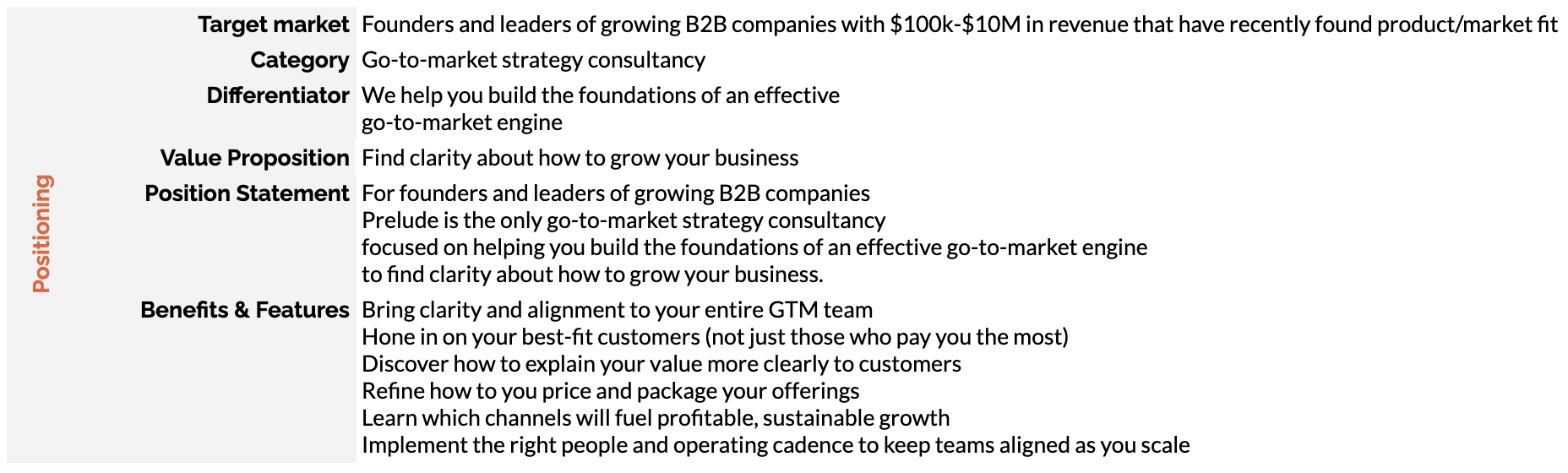
Target market: A short description of your most important, best-fit customers.
Category: The type of solution you provide. Defines your competitive set.
Differentiator: What makes you stand out against your competition?
Value Proposition: Defines the key benefit you promise your most important customers.
Position Statement: The position statement articulates your differentiated industry role and ultimate customer relevance.
Benefits & Features: Short descriptions of the benefits you promise target audiences and the associated product features.
Here's an example of what the output of your positioning workshop looks like in your messaging architecture:
A few positioning guidelines:
Positioning is the rational expression of your company's messaging. (Brand is the emotional.)
Positioning is about focus and sacrifice. It pinpoints your role and relevance in the next year or two and reaches only to spaces you can own soon. It may or may not reveal your sales strategy or long-term vision.
Positioning evolves. Focus only on positioning for the next 12-24 months.
Positioning is precise, concise, fact-based, and the foundation for all external messaging.
Positioning is not opinion or unfounded hyperbole, fluff, taglines, campaigns, or falsities.
Get your copy of my Positioning Workshop template here.
Phase 3: Brand Workshop
The next step is running your brand workshop with the same company leadership team.
This workshop also usually takes 2-3 hours to complete.
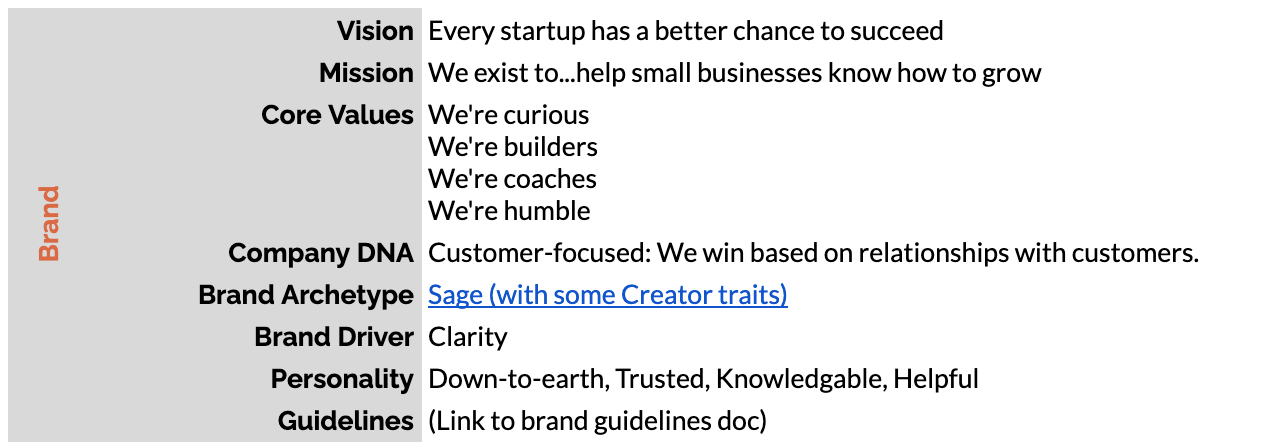
They should be to have a discussion that results in clarity and alignment on the eight parts of your brand:
Vision: The state of the world which you hope to see.
Mission: Your core purpose. Answers the question, "Why do we exist?"
Core Values: Natural, inherent traits in the best team members. Answers the question, "How do we behave?"
Company DNA: The type of DNA that drives your company. We are a (Customer, Product, Concept) driven company.
Brand Archetype: Your most dominant characteristic. One of twelve genres assigned your brand based on symbolism.
Brand Driver: The single, most important core concept around which the brand (emotional side of the company) is built.
Personality: The human characteristics of your brand. Reflects how you sound and want to be experienced.
Guidelines: The rules that guide visual and experiential representation of your brand in the wild.
Here's an example of what the output of your brand workshop looks like in your messaging architecture:
A few brand guidelines:
The brand is the emotional expression of your company's messaging. (Positioning is the rational.)
Branding is experiential. It includes the promise you deliver, the personality you embody, the experience customers have, and the feelings you elicit.
Good brands are unique, authentic, intangible, meaningful, scalable, and the foundation for your identity, colors, imagery, tone, and language.
Brands are most potent when:
Solid positioning is in place.
The company's values are clear.
There is a good understanding of the customer experience.
There is a commitment to standing out and being unique.
Get your own copy of my Brand Workshop template here.
Phase 4: Story Workshop
The last phase of the messaging architecture development process is to define your story or strategic narrative.
Your strategic narrative is the emotionally charged story that convinces and converts prospects. While your positioning and brand are more about your company, your story should be about your customers.
Two of my favorite examples of story frameworks with similar components are the StoryBrand framework (and book) by Donald Miller and the Strategic Narrative framework by Andy Raskin.
This workshop usually takes 1-3 hours to complete and is best done after positioning and brand are already in place.
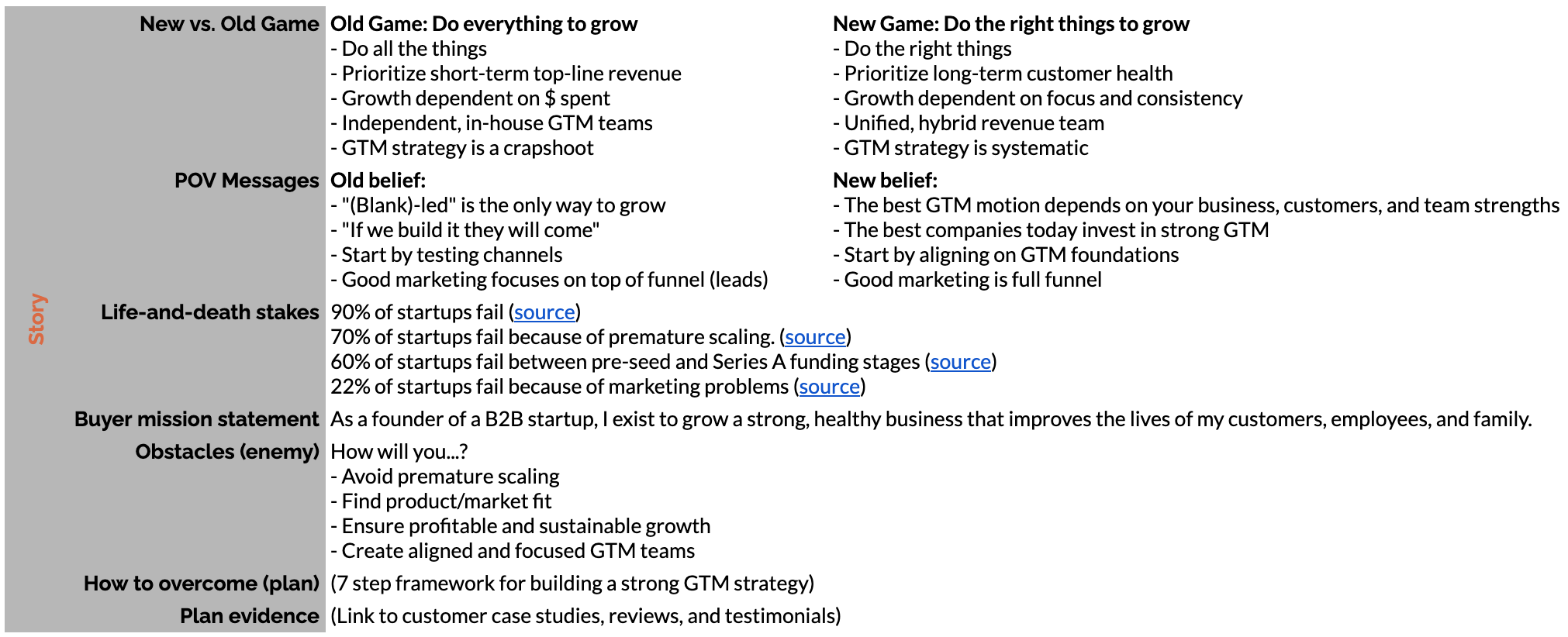
The same company leadership team should participate in this workshop. The goal is to align with the seven parts of your company story:
New vs. Old Game: Name and describe the new game and the old game in the world of your buyers.
POV Messages: Describe some commonly held beliefs about the old game you passionately disagree with.
Life-and-death stakes: Convey life-and-death stakes (winners are playing, losers are not). Describe success vs. failure.
Buyer mission statement: Boil down the object of the new game. What are buyers trying to achieve? Describe their promised land.
Obstacles (enemy): Present obstacles to winning or getting to their promised land. ("How will you…")
How to overcome (plan): Show your plan to help them overcome the obstacles. (Differentiators, features, approach)
Plan evidence: Present evidence that your plan works. (Customer success stories, testimonials, demos)
Here's an example of what the output of your story workshop looks like in your messaging architecture:
A few story guidelines:
Stories are a more effective way of communicating (hence why humans have told stories since the beginning of time).
"The company story is the company strategy." -Ben Horowitz, Partner and Co-founder, Andreessen Horowitz. Don't dismiss this as "fluffy marketing work." It is core to your company strategy.
Your story should be the foundation of your external messaging, including website copy, sales demos, pitch decks, outbound messaging, event speaking sessions, social content, QBR calls with customers, investor pitch decks, PR & analyst communications, etc.
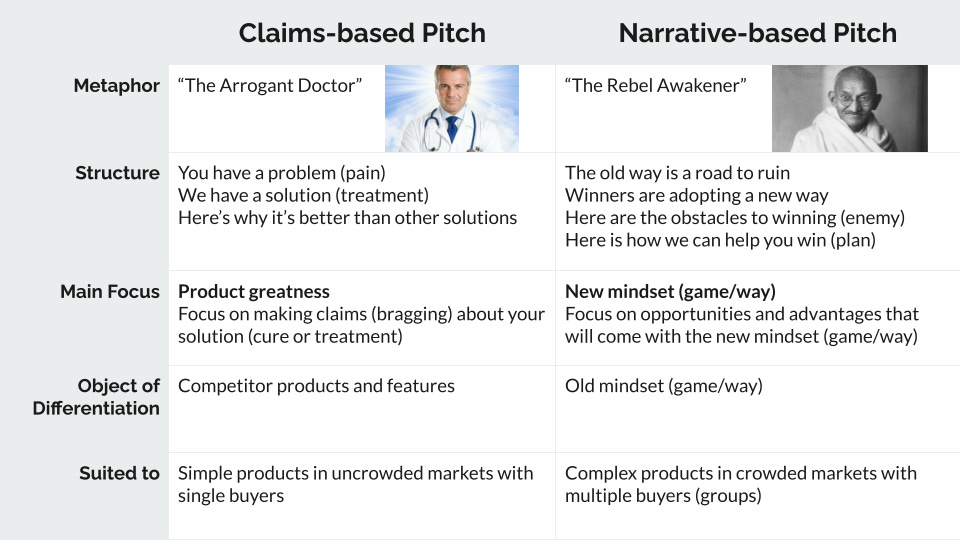
A narrative-based pitch is different (and more effective) from the traditional claims-based pitch in the following ways. It's essential to understand the differences.
Get your copy of my Story Workshop template here.
Conclusion
As mentioned above, your messaging architecture is the foundation for all external communication.
It also serves as a key artifact that keeps your teams aligned about how to speak about what you do and why you do it.
Building it is one of the most important activities you can do to clarify and ensure an understanding of your company strategy.
But since startups and markets move so fast, it becomes stale if you don't keep it updated.
If you already have a messaging architecture, ensure it's up-to-date and still used by your teams.
If you don't yet have a messaging architecture, create one. I guarantee it will be one of the most impactful things you do this year to help grow your business.